
Showing posts with label war. Show all posts

Tuesday, January 27, 2015

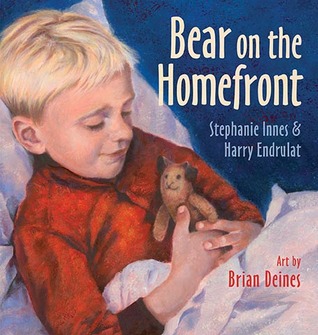
Bear on the Homefront by Stephanie Innes & Harry Endrulat


20863446During World War II, 10,000 children from British cities were sent to live with host families in Canada, the United States, and other nations away from the war zone. Bear on the Homefront tells the story of two guest children, Grace and William Chambers, who arrive in Halifax and meet Aileen Rogers, a nurse serving on the homefront. With her is Teddy, the stuffed bear whose real-life trip to the front lines of World War I and back was chronicled in A Bear in War.Using archival images and Aileen Rogers’ wartime diary, Stephanie Innes and Harry Endrulat piece together William and Grace’s journey by train to their host family’s Winnipeg farm. Readers experience the story through Teddy’s eyes as Aileen, seeing William’s anxiety, lets her stuffed friend stay with the little boy throughout the train ride and, ultimately, throughout the war. Brian Deines’ soulful oil paintings capture the spirit of the war years on the homefront. His expressive art communicates both the loneliness of children separated from their families and the joyful conclusion when Grace, William, and Teddy all return to their homes again.

A sweet book that centers on how two children, Grace and William, feel being so far from home and all they know.  This story will be great for Remembrance Day, especially for younger grades where stories of war may be to dark for some.  I can also see this as being a good book for anyone who is in a new place or situation and unsure of what lies ahead.   Beautifully illustrated and gently told, Bear on the Homefront is a new favorite.
-------------
6136672
Check out Teddy's first adventures in WW1.

Teddy belonged to ten-year-old Aileen Rogers, whose father Lawrence left Aileen, her little brother Howard, and his wife Janet home on the family farm in Quebec when he went to war. Janet and Lawrence exchanged more than 200 letters during his service. Aileen and Howard also wrote their dad -- and Aileen sent her beloved Teddy overseas to help protect him. Sadly, Lawrence died at the battle of Passchendaele. In 2002, his granddaughter Roberta Innes found Teddy and the letters in an old family briefcase. Her findings uncovered how a Canadian family's strength was tested by war and how a small stuffed bear became an enduring memento of their love.


Thursday, November 6, 2014

Why We Wear a Poppy ... Books that Help Explain Remembrance Day to Primary Students


On November 11, especially, but also throughout the year, we have the opportunity to remember the efforts of these special Canadians. In remembering, we pay homage to those who respond to their country's needs. On November 11, we pause for two minutes of silent tribute, and we attend commemorative ceremonies in memory of our war dead.
Following the First World War a French woman, Madame E. Guérin, suggested to British Field-Marshall Earl Haig that women and children in devastated areas of France could produce poppies for sale to support wounded Veterans. The first of these poppies were distributed in Canada in November of 1921, and the tradition has continued ever since, both here and in many parts of the world.
Poppies are worn as the symbol of remembrance, a reminder of the blood-red flower that still grows on the former battlefields of France and Belgium. During the terrible bloodshed of the second Battle of Ypres in the spring of 1915, Lieutenant-Colonel John McCrae, a doctor serving with the Royal Canadian Army Medical Corps, wrote of these flowers which lived on among the graves of dead soldiers:

In Flanders Fields the poppies blow
Between the crosses, row on row,
That mark our place; and in the sky
The larks, still bravely singing, fly
Scarce heard amid the guns below.
John McCrae
The flowers and the larks serve as reminders of nature's ability to withstand the destructive elements of war by men, a symbol of hope in a period of human despair. In Canada, traditionally the poppies which we wear were made by disabled Veterans. They are reminders of those who died while fighting for peace: we wear them as reminders of the horrors of conflict and the preciousness of the peace they fought hard to achieve.

(source: How Do We Remember, Veterans Affairs Canada)


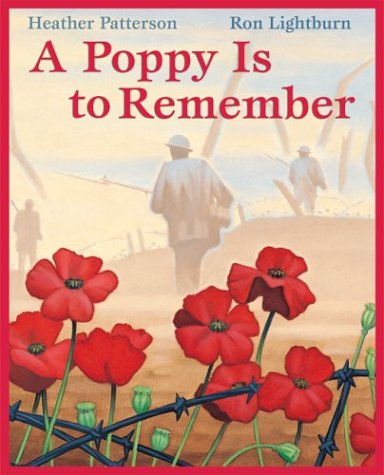
A Poppy Is to Remember  A Poppy is to Remember by Heather Patterson

This book helps to explain Remembrance Day and the importance of remembering and paying tribute to Canadian soldiers past and present. Includes a history of the poppy as a symbol of remembrance and of how to use poppies. The poem, In Flanders Field, is included.


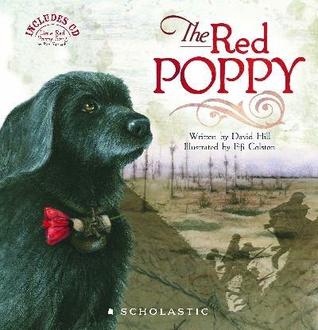
The Red Poppy The Red Poppy by David Hall

Nipper is a messenger dog during World War I, carrying valuable information between the trenches and the battlefield. Along with Nipper, the story shows 2 enemy soldiers and their realization that uniforms and lines on a map can not erase the humanity between the two men. As they struggle to survive, they share stories, help one another and offer each other hope until they decide to rely on Nipper to escape their perilous situation.


poppyThe Poppy Lady by Barbara Elizabeth Walsh

Moina Belle Michael, a college professor from Georgia, first pinned poppies to soldier’s uniforms after reading the poem In Flanders Fields. She wanted to honor the soldiers and those who had died. Moina had been training to become a YMCA canteen worker at Columbia University’s Y headquarters to help World War I soldiers overseas. But when she completed training, she was then told she was too old to go.
So, she stayed behind doing what she can when she got the idea to establish the Flanders Field Memorial Poppy as a universal symbol of tribute and support for veterans and their families during World War I and II. Known as the Poppy Lady, Michael dedicated her life to servicemen and women, buying and placing fresh flowers in rooms where they would gather before heading overseas.

Where the Poppies Now Grow by Hilary Robinson
The carefree childhood for Ben and his best friend Ray becomes a distant memory when they join the army to serve their country. But, in the midst of battle can their friendship survive? Published to mark the centenary of the start of the First World War and in homage to the war poets Where The Poppies Now Grow, written in rhyme with powerful illustrations, is a touching tribute to honour all those who sacrificed so much for peace.

Thursday, October 24, 2013

My Favorite November 11th books

At the 11th hour of the 11th day of the 11th month
Remembrance Day honours the sacrifices of the men and women of the armed forces who fought for our freedom.  How can we introduce the meaning and importance of showing respect and thanks on this special day to young children?


A Bear in War
written by Stephanie Innes and Harry Endrulat

 Inspired by the true story of “Teddy,” a stuffed bear that was sent to the front lines during World War I. Teddy belonged to ten-year-old Aileen Rogers, who lived with her family on a farm in East Farnham, Quebec. Her father, Lawrence Browning Rogers, enlisted in the Fifth Canadian Mounted Rifles in his thirty-seventh year in 1915.  Teddy now lives in a glass display case at the Canadian War Museum  in Ottawa, Canada.


Proud as a Peacock, Brave as a Lion written by Jane Barlcay

Much has been written about war and remembrance, but very little of it has been for young children. As questions come from a young grandchild, his grandpa talks about how, as a very young man, he was as proud as a peacock in uniform, busy as a beaver on his Atlantic crossing, and brave as a lion charging into battle. Soon, the old man’s room is filled with an imaginary menagerie as the child thinks about different aspects of wartime. But as he pins medals on his grandpa’s blazer and receives his own red poppy in return, the mood becomes more somber. 

Outside, the crowd gathered for the veterans’ parade grows as quiet as a mouse, while men and women — old and young — march past in the rain. A trumpet plays and Grandpa lays a wreath in memory of his lost friend. Just then, the child imagines an elephant in the mist. “Elephants never forget,” he whispers to his grandpa. “Then let’s be elephants,” says the old man, as he wipes water from his eyes and takes his grandson’s hand.


A Poppy is to Remember 
by Heather Patterson

How did the bright red poppy that we all wear in November become Canada's symbol of honouring those who fought for our freedom on Remembrance Day?
Moving text coupled with stunning illustrations by Governor General's Award-winning artist Ron Lightburn explain the symbolism behind the poppy.
A bonus for teachers is the five-page spread all about the poem, "In Flanders Fields," Canada's wartime and peacekeeping endeavours, and the adoption of the poppy as our Remembrance Day emblem.


The Peace Book by Todd Parr

The Peace Book delivers positive and hopeful messages of peace in an accessible, child-friendly format featuring Todd Parr''s trademark bold, bright colors and silly scenes. Targeted to young children first beginning to read, this book delivers a timely and timeless message about the importance of tolerance.


Why? by Nikolai Popov

A frog sits peacefully in a meadow. Suddenly, for no apparent reason, he is attacked by an umbrella-wielding mouse in a confrontation that quickly turns into a full-scale war. "A strong anti-war message and lithe, incandescent artwork propel this affecting wordless picture book".--"Publishers Weekly".


Why We Remember  written and illustrated by students from Graysville School in Graysville, Manitoba                                                                                    A book explaining the importance of celebrating Remembrance Day, written by Canadian children. 


And for older children...