Mac Barnett is the author of fifteen books for children. He was the executive director of 826LA, a nonprofit writing center, and founded the Echo Park Time Travel Mart, a convenience store for time travelers. In this talk about creativity and wonder, he explains why kids are the ideal readers of literary fiction -- and what adults can learn from them about imagination and the willing suspension of disbelief.

Showing posts with label children. Show all posts
Showing posts with label children. Show all posts
Thursday, January 29, 2015
Why a Good Book is a Secret Door
Mac Barnett is the author of fifteen books for children. He was the executive director of 826LA, a nonprofit writing center, and founded the Echo Park Time Travel Mart, a convenience store for time travelers. In this talk about creativity and wonder, he explains why kids are the ideal readers of literary fiction -- and what adults can learn from them about imagination and the willing suspension of disbelief.


Tuesday, January 27, 2015
Bear on the Homefront by Stephanie Innes & Harry Endrulat
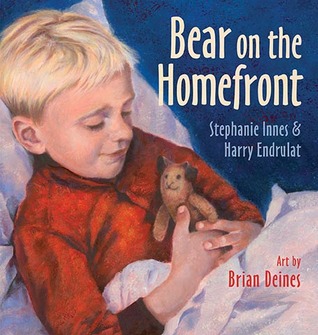 During World War II, 10,000 children from British cities were sent to live with host families in Canada, the United States, and other nations away from the war zone. Bear on the Homefront tells the story of two guest children, Grace and William Chambers, who arrive in Halifax and meet Aileen Rogers, a nurse serving on the homefront. With her is Teddy, the stuffed bear whose real-life trip to the front lines of World War I and back was chronicled in A Bear in War.Using archival images and Aileen Rogers’ wartime diary, Stephanie Innes and Harry Endrulat piece together William and Grace’s journey by train to their host family’s Winnipeg farm. Readers experience the story through Teddy’s eyes as Aileen, seeing William’s anxiety, lets her stuffed friend stay with the little boy throughout the train ride and, ultimately, throughout the war. Brian Deines’ soulful oil paintings capture the spirit of the war years on the homefront. His expressive art communicates both the loneliness of children separated from their families and the joyful conclusion when Grace, William, and Teddy all return to their homes again.
 A sweet book that centers on how two children, Grace and William, feel being so far from home and all they know. This story will be great for Remembrance Day, especially for younger grades where stories of war may be to dark for some. I can also see this as being a good book for anyone who is in a new place or situation and unsure of what lies ahead. Beautifully illustrated and gently told, Bear on the Homefront is a new favorite.
-------------

Check out Teddy's first adventures in WW1.
Teddy belonged to ten-year-old Aileen Rogers, whose father Lawrence left Aileen, her little brother Howard, and his wife Janet home on the family farm in Quebec when he went to war. Janet and Lawrence exchanged more than 200 letters during his service. Aileen and Howard also wrote their dad -- and Aileen sent her beloved Teddy overseas to help protect him. Sadly, Lawrence died at the battle of Passchendaele. In 2002, his granddaughter Roberta Innes found Teddy and the letters in an old family briefcase. Her findings uncovered how a Canadian family's strength was tested by war and how a small stuffed bear became an enduring memento of their love.
Tuesday, November 25, 2014
International Day for the Elimination of Violence Against Women
Women's activists have marked November 25th as a day against violence since 1981. This date came from the brutal assassination in 1960, of the three Mirabal sisters, political activists in the Dominican Republic. Governments, international organizations and NGOs are invited to organize activities designed to raise public awareness of the problem on this day.
Violence against women continues to be a global pandemic and impacts on, and impedes, progress in many areas, including poverty eradication, combating HIV/AIDS, and peace and security. Violence against women is a consequence of discrimination against women, in law and also in practice, and of persisting inequalities between men and women.
Physical. Sexual. Psychological. Economic. Violence against women takes many forms and affects women from childhood to old age. The roots of violence against women lie in persistent discrimination against women. Women who experience violence suffer a range of health problems and their ability to participate in society is diminished. This violence does not observe distinctions of culture, religion, race or age. It harms families, communities across generations and reinforces other violence prevalent
So how do we address this in the library? There are several books available that can help approach these sensitive subjects with our young patrons on both an individual level and as a global issue.
I like that these books use animals as characters rather than people. I think that it allows young readers to distance themselves from frightening situations without taking away any of the impact and validity of the situations described.
 A Terrible Thing Happened by Margaret M. Holmes
Sherman Smith saw the most terrible thing happen. At first he tried to forget about it, but something inside him started to bother him. He felt nervous and had bad dreams. Then he met someone who helped him talk about the terrible thing, and made him feel better.
Holmes has written a book that doesn't pretend that thing will go back to the way they were, but instead lets the reader know that many emotions can result from a tragedy such as anger, sadness, fear and that acting out can result when these emotions are hidden or ignored. Finding someone to talk to can help. There is also some information for caregivers at the end. We never learn what the terrible thing that happened to Sherman is, making this book relatable for all kinds of situations: bullying, divorce, abuse, death, accident, crime, and so on.

On a Dark, Dark Night by Sara B. Pierce
A bear cub sees his father strike his mother. He runs away, and is comforted by his friend Moose, who brings in another friend, Eagle. Eagle, taking on the role of the police officer, goes to the father bear and talks to him. Eagle brings him before the animal council, which Pierce calls “the animals’ version of our judicial system.” The council decides that the father bear can no longer stay in the village. Several seasons pass, the father returns, and he and the mother bear begin to talk about whether he can return home or whether he needs more time alone. The story leaves what happens next unsaid making the book suitable for a variety of situations.
Violence against women continues to be a global pandemic and impacts on, and impedes, progress in many areas, including poverty eradication, combating HIV/AIDS, and peace and security. Violence against women is a consequence of discrimination against women, in law and also in practice, and of persisting inequalities between men and women.
Physical. Sexual. Psychological. Economic. Violence against women takes many forms and affects women from childhood to old age. The roots of violence against women lie in persistent discrimination against women. Women who experience violence suffer a range of health problems and their ability to participate in society is diminished. This violence does not observe distinctions of culture, religion, race or age. It harms families, communities across generations and reinforces other violence prevalent
So how do we address this in the library? There are several books available that can help approach these sensitive subjects with our young patrons on both an individual level and as a global issue.
I like that these books use animals as characters rather than people. I think that it allows young readers to distance themselves from frightening situations without taking away any of the impact and validity of the situations described.
 A Terrible Thing Happened by Margaret M. Holmes
Sherman Smith saw the most terrible thing happen. At first he tried to forget about it, but something inside him started to bother him. He felt nervous and had bad dreams. Then he met someone who helped him talk about the terrible thing, and made him feel better.
Holmes has written a book that doesn't pretend that thing will go back to the way they were, but instead lets the reader know that many emotions can result from a tragedy such as anger, sadness, fear and that acting out can result when these emotions are hidden or ignored. Finding someone to talk to can help. There is also some information for caregivers at the end. We never learn what the terrible thing that happened to Sherman is, making this book relatable for all kinds of situations: bullying, divorce, abuse, death, accident, crime, and so on.

On a Dark, Dark Night by Sara B. Pierce
A bear cub sees his father strike his mother. He runs away, and is comforted by his friend Moose, who brings in another friend, Eagle. Eagle, taking on the role of the police officer, goes to the father bear and talks to him. Eagle brings him before the animal council, which Pierce calls “the animals’ version of our judicial system.” The council decides that the father bear can no longer stay in the village. Several seasons pass, the father returns, and he and the mother bear begin to talk about whether he can return home or whether he needs more time alone. The story leaves what happens next unsaid making the book suitable for a variety of situations.
Tuesday, May 6, 2014
Books for the "Where do I Come From?" question
Children can start to ask about sex and babies at any time. Knowing when to start having those discussions and what to say can be very intimidating. How much information do you give? Do you only answer what was asked or should you offer more information? How do you explain mature concepts to a child? How much is too much? Not enough?
Each parent need to decide these answers for themselves. Be honest and factual and be prepared for many little conversations rather than a single big one. This not only takes the pressure off the parents to have the perfect answers, it allows both the children and parents time to digest the information.
There are many books available that can help broach the subject and help to illustrate the biology of puberty and sex. These three titles offer varying degrees of detail and illustrations

What Makes A Baby
Geared to readers from preschool to age eight, What Makes a Baby is a twenty-first century children's picture book about conception, gestation, and birth. It illustrates a variety of family compositions without being specific about gender people or body parts, so most parents and families will find that it can reflect their own experiences.
Where Willy Went
by Nicholas Allan

Willy is a little sperm who lives inside Mr. Browne with 300 million friends. Every day Willy practices for the Great Swimming Race. And when the day arrives, he swims faster than his 300 million friends to win the prize—a marvelous egg. Then something wonderful happens, and eventually Mr. and Mrs. Browne have a baby girl who has the same winning smile as Willy and who grows up to be a great swimmer. The cartoon illustrations explain how babies are made without being terribly specific about the act of sex. I like that it introduces the concept of genetics.
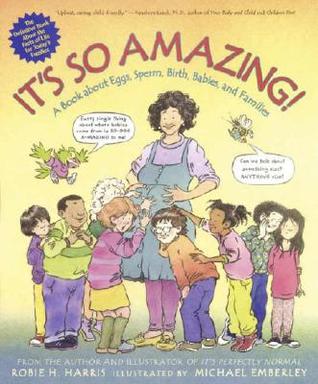
by Robie H. Harris
This book was created in response to repeated requests from parents, teachers, librarians, and health professionals for an up-to-date book about sex and sexuality for young children. Using language that kids will understand, it covers many subjects related to reproduction. I liked that it covered so many situations, from natural conception to doctor-aided pregnancies, and included a variety of family situations. Some readers may be uncomfortable with some of these topics, such as briefly discussing abortion, Aids/HIV and masturbation, but I found it very easy to use the sections somewhat independently from others. This is a resource that adults can come back t again and again as new questions arise from children. The information is straightforward and factual (no storks here), however I recommend reading ahead so that you are familiar with both the text and the pictures and can then decide what is appropriate for your child.
Monday, January 14, 2013

Subscribe to:
Posts (Atom)