Showing posts with label co-operative reading. Show all posts

Tuesday, September 23, 2014

Study shows that kids read for fun less and less.


Despite the popularity of young adult series like Harry Potter, Hunger Games and the Divergent series, are reading rates dropping?

New research released in May 2014 from Common Sense Media finds that reading rates don't just fall as kids grow up, but they've also dropped dramatically over the last three decades, with 45 percent of 17-year-olds admitting they read by choice only once or twice a year. That is down more than 50% from the last decade. The research reviews national surveys and databases to identify trends in childrens' and teens' reading rates and achievements. 

Jim Steyer of Common Sense Media says that "Kids with parents who read, who buy or take books out of the library for their kids, and who then set time aside in their kids' daily schedule for reading, tend to read the most," — whether it's on a book, an e-book or some other gadget.  This isn't news to educators.  Parents who model reading and who spend some time ever week reading with their kids are able to instill an enjoyment of leisure reading.
source: Notesfromtheslushpile.com
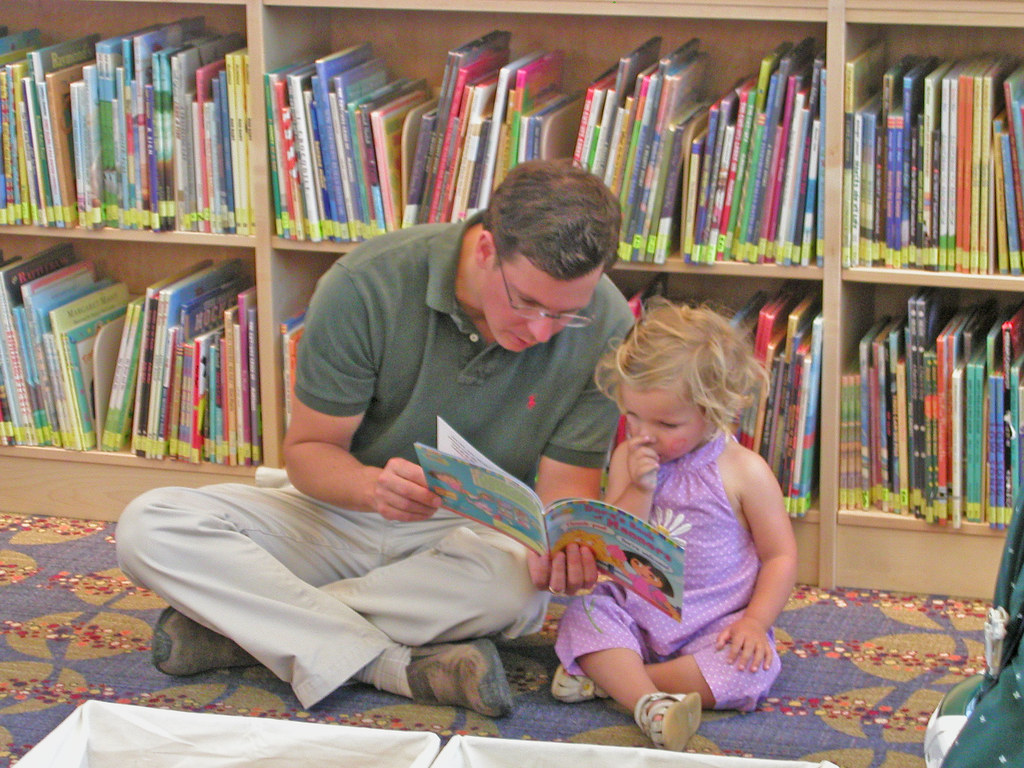
Parents who introduce the family to the public library and make regular visits also bring the gift of a near endless supply of free books to their children and teens. When book stores are too expensive or someone just wants to try a books out, the shelves of the library can carry a reader along beyond the encouragement to simply pick up a book.
source: flickr.com

Luckily, e-reading seems to be gaining some momentum and can be substituting for some of the paper book version.

A summary of the research brief from Common Sense Media can be seen in this infographic. 


------------
Common Sense Media is a non-profit national organization led by concerned parents and individuals that provide advocacy and support in the areas of the safe use of technology and education for children.  The full report can be found here.

Tuesday, July 22, 2014

The Gift's Reading to Our Children Brings


Life is not easy, nor is it fair, or always fun. But stories are always there, waiting to comfort you, to excite you, and to let you imagine a world which works the way you want it to.

-Robin Jeffrey from her blog post "Inspiration - Storytime with Wind in the Willows" about the gifts she's been given from her parents, especially her father, reading out loud to her as a child. Click the link to read her post.


Thursday, May 1, 2014

Home Summer Reading Program

There are many organized summer reading programs available in most communities.  Public libraries, schools, camps and churches often have some version to promote reading for fun over the school breaks.
Want more than what is offered through formal reading programs or facing reluctant participants? Or maybe you are travelling but still want a way to keep those young minds active.  Adjust existing programs or customize your own home program for your kids to match their needs and challenge their range. The following idea comes from the Create Your Own Summer Reading Program By Laureen Miles Brunelli as posted on Work-At-Home Moms
You could do a similar summer reading program, making it more or less complicated.
  • I created a spreadsheet with a column for the weeks of the summer and a row across the top with each child’s name.
  • I created prize card with rewards like:
    • Get out of dishes free
    • 30 minutes computer, Wii or TV time during "non-electronic time"
    • 1 song from iTunes
    • Trip to the dog park (Mom and Dad, but not the pooch, grew weary of this one!)
    • Stay up late
    • Sleep in late

  • Kids earn one point for each page read. We entered the number of pages read by each kid every few days. (It was an honor system, but on a separate page I kept track of the titles and the last page read to head off any exaggerations or confusion.) Kids could also earn bonus points when they finished a book, worked on summer homework or listened to an audiobook.
  • On Sundays we awarded first- and second-place prizes to the kids who had the most points, letting them choose from the prize cards. And if everyone had earned at least 150 points, we went out for ice cream.
  • I set both short- and long-term prizes to keep interest in the program from waning midsummer. I awarded weekly, monthly and a grand prize. The monthly prizes were drawings for toys, gift cards and other item valued at about $10. Kids earned entries into the drawings when they read 100 pages or finished a book. So even the third place weekly winner, four weeks running had a shot at the monthly prize.
  • The person with the most points at the end of the summer won a cash prize. And we all ordered pizza and celebrated ourselves too.
Track the kids progress and keep the program fresh by creating a visual space.  Post book titles, achievements, library due dates, reaction papers, etc.   Get the whole family involved and create a spot from Mom, Dad and grandparents too!

Remember that reading is not just about  books.  Count magazines, newspapers, graphic novels, fiction and non-fiction.

Saturday, April 19, 2014

A Love for Reading: Lead by Example

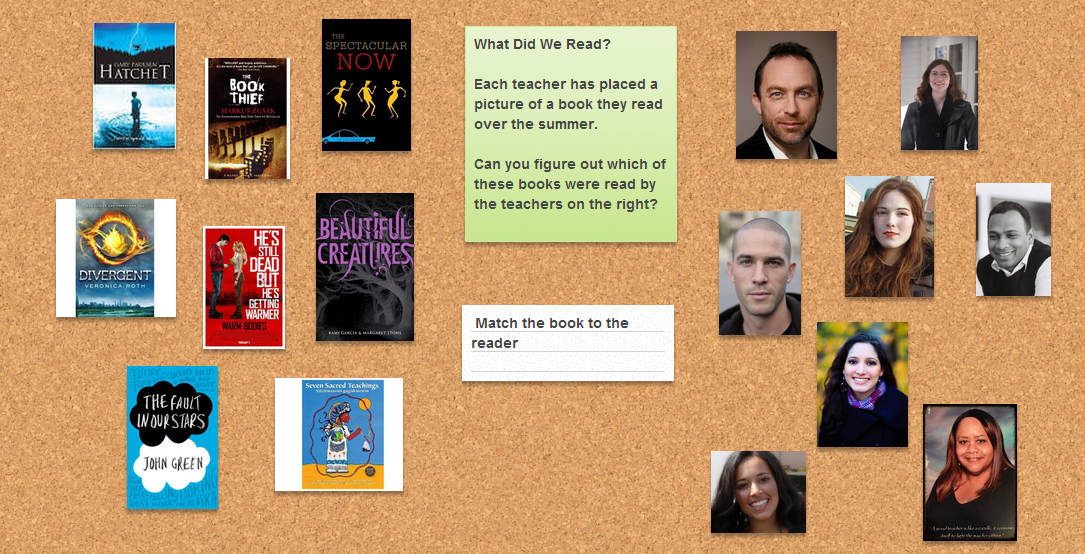
A great way to encourage reading and teach students how fun it can be is to model reading.  One of my schools created a picture wall in the library.   Since then, other schools have customized it for their needs.  Some made a simple display, others turned it into a contest and one asked students to bring in their own pictures to add.
This is a mock up of a contest where students are challenged to match the book cover to the staff member who read it.
It started as a promotion for Summer Reading and was easy to create. Ask your staff - teachers, custodians, support staff, principals, volunteers - to bring in or email photos of themselves reading over the summer. Encourage people to get creative. It doesn't just have to be of the person sitting in a chair holding a book, although that is fine too. As you can see from some of these pictures below, there are a lot of options. The only limitations is the reader's creativity.  I have seen pictures of people holding a book on a roller coaster, dressed up in tuxedos and others dressed in vibrant PJs or onesies with fuzzy bunny slippers.  Do anything to have fun with the picture.

Is your staff camera shy? Don't let them miss out on this!  I have had people submit pictures of their pets reading or pictures in silhouette of them reading, or even pictures of the book from their point of view with the book on their lap and their feet stretched out in front.  They can set up a scene of where they read such as reading at the beach with a snap of  the book with sunglasses, a sunscreen bottle and  a sun hat. 

If people are reading with their families but don't want the kids pictures to show publicly, they can take pictures from behind,  showing the backs of their heads.   Model co-reading by including the whole family.

Include an info bite.  The captions can say anything, again,  be creative.  Tell where you were reading, the title of the book, a quote from the book,  what you liked about the book or author.  Add recommendations or what you will read next.


Have fun with it and create a great display for back-to-school.  Or reading week.  Or any time!

Monday, January 27, 2014

Family Literacy Day is Today

Family Literacy Day
Family Literacy Day is a national awareness initiative created by ABC Life Literacy Canada in 1999 and held annually on January 27 to raise awareness of the importance of reading and engaging in other literacy-related activities as a family.

Taking time every day to read or do a learning activity with children is crucial to a child's development. Even just 15 minutes a day can improve a child's literacy skills dramatically, and can help a parent improve their skills as well.

Read More, here: http://abclifeliteracy.ca/family-literacy-day-2014

Try one of these 15 minute activities to practice daily literacy in your home:
  1. Write a joke book with your family.
  2. Read a bedtime story to the grown-up putting you to bed.
  3. Make up a new recipe together and post it online.
  4. Tell knock-knock jokes together while doing the dishes.
  5. Organize a book swap at your school.
  6. Make up riddles and tell them to your friends.
  7. Create a family book club.
  8. Build a drum with your family.
  9. Surf the Internet and learn about your favourite animal.
  10. Make up a song about your day to sing to your family at dinnertime.
  11. Write messages to your family on sticky notes and post them around the house.
  12. Create a story about what you’ll be doing for Family Literacy Day.
  13. Play a board game together.
  14. Build an acrostic poem using your hero’s name.
  15. Make an origami boat and see if it will float.

Thursday, March 21, 2013

A Book in Any Language ...

I work on a daily rotating schedule at 8 elementary schools.  Yes, I said 8.  That's a lot of collections and student names to remember.  In the last few years I have come across something else to remember.  Many of the new students are recent immigrants.  They come from all over the world and for many, English is a second language.  Most of these children are first-generation English speakers.  So how can we adjust our home reading programs to accommodate parents and grand-parents who can not read the books we send home with the kids?

We have a fledgling Dual Language collection, but with so many languages and a dwindling yearly budget, it is simply not possible to purchase a decent collection for all my students.  My various libraries can trade books, but with over 20 different languages that need to be represented in this year's class, we simply don't have the resources.

Digital Age Rescue


The International Children's Digital Library offers a solution.  This searchable database contains picture books in every language I have needed.  Students can be shown the site at school and sent home with a simple instruction guide.  I have had parents and grandparents respond positively.  Many are thrilled that they can now participate in reading with the children and they are happy to support their native language and culture as well.
By supporting literature in both the mother tongue and English, a positive, inclusive attitude is presented to new students and their families.  This goes a long way in  fostering self-confidence in students and participation by the family in their children's education.